Interactive Astrology Calculator – Learn How Lagnam, Rasi, Navamsam & Vimshottari Dasha-Bhukti Are Computed
Interactive educational tool to understand how Indian astrology charts are calculated. Explore heliocentric and geocentric planetary positions, Lagna computation, Rasi (D1), Navamsa (D9), Nakshatra, and Vimshottari Dasha with the mathematical basis behind each calculation.
Dasa05 Mar 2025 | 1 min read
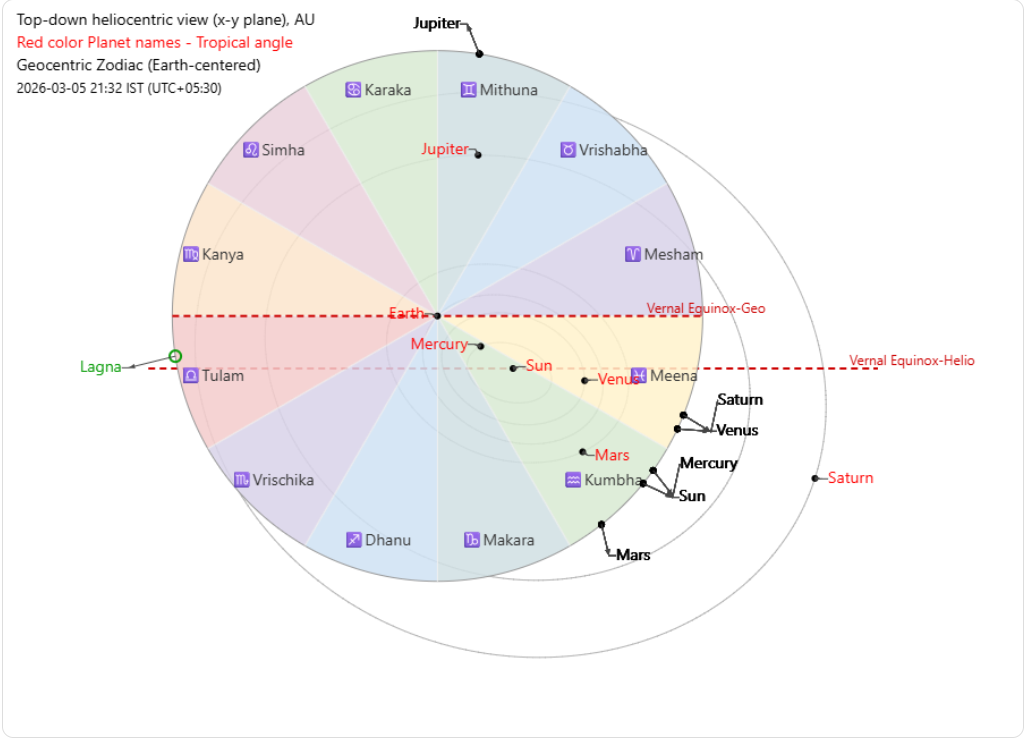
This page provides an educational visualization of how key elements of an Indian birth chart are computed from astronomical principles. The top-down heliocentric view shows the positions of the planets around the Sun, while an overlaid geocentric zodiac circle centered on Earth illustrates how planetary longitudes are measured from the Earth’s perspective. Using these geocentric positions, the page derives the Lagna (Ascendant), Rasi (D1) chart, Navamsa (D9) chart, Nakshatra, and the Vimshottari Dasha and Bhukti timelines. The accompanying tables list the calculated planetary longitudes and related parameters, allowing readers to understand both the visual representation and the mathematical basis behind each step of the chart construction.